

Google’s New Bidding Update Could Increase Your Cost Per Lead
Google’s New Bidding Update Could Increase Your Cost Per Lead
Google’s New Bidding Update Could Increase Your Cost Per Lead
Google Ads made an important change today, August 17, 2026, and if you are running campaigns using Target CPA or Target ROAS, it is worth taking a look at your account.
Especially if Google is telling you that your campaign is Limited by budget.
The change sounds relatively simple. Google says its bidding system will now work more consistently toward the CPA or ROAS target you actually entered into the campaign.
That sounds like a good thing, and in many cases, it probably is… but there is an interesting catch.
Some advertisers have campaigns that have been performing significantly better than the target they gave Google. Those campaigns may now become more expensive.
What exactly changed?
Google's automated bidding system allows advertisers to tell Google what kind of performance they want.
With Target CPA, you are essentially telling Google how much you are willing to pay for a conversion. With Target ROAS, you are telling Google the return on advertising spend you want the campaign to work toward.
Until now, campaigns that were limited by budget could sometimes significantly outperform those targets.
Beginning August 17, Google says those campaigns will more consistently optimize toward the target you entered, even when budgets change.
That distinction is important.
Imagine that your Target CPA is set to $100. You are telling Google that you are willing to spend roughly $100 to generate a conversion. But over the last few months, Google has actually been producing those conversions for $60.
Great.
The problem is that your campaign still says you are willing to pay $100.
Under the new bidding behavior, Google may begin optimizing closer to that $100 target instead of continuing to significantly outperform it. Google actually gives a similar example in its documentation. A campaign with a $10 Target CPA that had been achieving a $5 actual CPA could begin delivering closer to the $10 target after the change.
That is a pretty significant difference.
Google is going to take your target more seriously
This is probably the simplest way to understand the update.
If you tell Google you are comfortable paying a certain amount, make sure you actually mean it.
Previously, advertisers could have a campaign with a relatively loose Target CPA while enjoying much better actual performance. The campaign might say $100 while consistently generating customers at $60.
You could look at the $60 and assume everything was working perfectly, but Google is now making the target itself much more meaningful for campaigns affected by this update.
If $60 is what you actually want to pay, it may be time to tell Google $60.
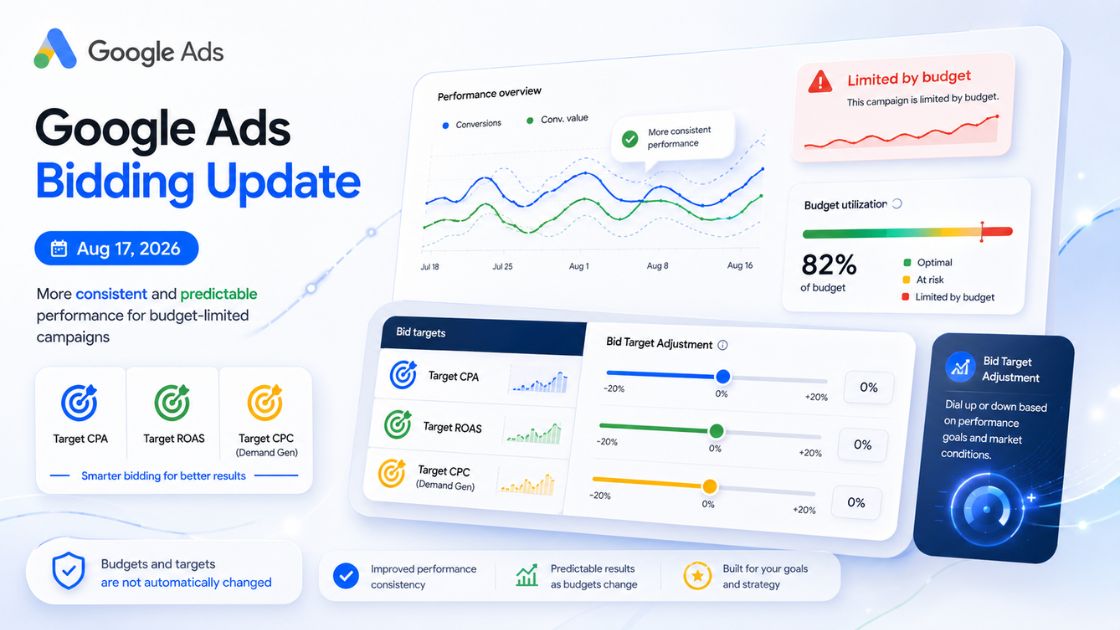
Google has introduced a Bid Target Adjustment Tool specifically to help advertisers review these campaigns and update their targets. Google says the tool is now available in Google Ads.
Who should be paying attention?
Not every Google Ads campaign is affected. The biggest thing to look for is Limited by budget. Google says Target CPA and Target ROAS campaigns that are not budget constrained will not change behavior because of this update. The update applies across several major campaign types, including Search, Shopping, Performance Max, Demand Gen and Travel campaigns.
So if you have a campaign that:
Uses Target CPA or Target ROAS
Is limited by budget
Has been performing better than the target you entered
You should probably be looking at it today.
Does this mean Google is increasing your advertising budget?
No.
Google specifically says it is not automatically increasing advertisers' daily budgets or changing their bid targets. Your existing budget limits will still be respected.
This is a change to how Google's bidding system uses the target you already gave it. That is an important distinction. Your campaign might spend the same amount of money while generating fewer conversions if your CPA rises. Or, depending on your campaign and available demand, the system could change how aggressively it participates in auctions in order to move performance closer to your stated target.
Performance Max and Demand Gen advertisers may also notice changes in how spending is distributed between channels.
Why is Google doing this?
There is actually some logic behind the change.
Google says the old behavior could make scaling unpredictable.
Imagine your campaign has a $100 Target CPA but is producing leads at $60 because the campaign is limited by budget.
You increase the budget expecting more $60 conversions.
Then performance suddenly moves closer to $100.
From the advertiser's perspective, increasing the budget just made the campaign significantly less efficient.
Google says the new system is designed to make scaling more predictable because the bidding system should perform more consistently toward the target regardless of the campaign's budget limit.
That could ultimately be useful.
But it also means advertisers need to be much more intentional about the targets they give Google.
What should advertisers do now?
Start by opening Google Ads and looking at campaigns using Target CPA or Target ROAS.
Then look for campaigns marked Limited by budget.
Compare the target you have entered against your actual recent performance.
If your Target CPA is $150 but your campaign has consistently generated conversions for $90, ask yourself a very simple question:
Am I actually willing to pay $150?
If the answer is no, your target probably does not accurately represent your business goals. The same thinking applies to Target ROAS. Your bidding target should not simply be a number that made the algorithm work six months ago. It should represent what a customer, sale or conversion is actually worth to your business.
Google says advertisers can keep their existing target, adjust it to recent performance, choose a new custom target, change bidding strategies or increase the campaign budget depending on their goals.
Do not panic if performance moves around
Because the update begins August 17, some campaigns may experience temporary changes in traffic and performance. Google recommends evaluating performance over one to two conversion cycles after target adjustments rather than reacting immediately.
Google has also warned that some forecasting tools may be temporarily less accurate during the transition period from August 17 through August 31.
So this probably is not the time to start making drastic changes every morning because yesterday looked different.
Look at the data. Understand what your customer is worth. Set targets around the economics of your business. Then give the system enough information and time to work.
The bigger lesson for advertisers

Automated bidding keeps becoming more powerful, but automation does not eliminate strategy. It actually makes strategy more important.
Google can optimize toward almost any number you give it. The question is whether you gave it the right number in the first place. If your account says you are willing to pay $200 for a customer, Google does not know that your business really needs those customers at $120 to stay profitable.
You do.
That is why marketing cannot simply be putting campaigns on autopilot and checking the number of leads at the end of the month.
You have to understand what those leads are worth.
You have to understand margins.
You have to understand conversion rates.
And most importantly, you have to make sure the goals you are giving the advertising platforms actually match the goals of the business.
Google's August 17 bidding update makes that more important than ever.
Google Ads made an important change today, August 17, 2026, and if you are running campaigns using Target CPA or Target ROAS, it is worth taking a look at your account.
Especially if Google is telling you that your campaign is Limited by budget.
The change sounds relatively simple. Google says its bidding system will now work more consistently toward the CPA or ROAS target you actually entered into the campaign.
That sounds like a good thing, and in many cases, it probably is… but there is an interesting catch.
Some advertisers have campaigns that have been performing significantly better than the target they gave Google. Those campaigns may now become more expensive.
What exactly changed?
Google's automated bidding system allows advertisers to tell Google what kind of performance they want.
With Target CPA, you are essentially telling Google how much you are willing to pay for a conversion. With Target ROAS, you are telling Google the return on advertising spend you want the campaign to work toward.
Until now, campaigns that were limited by budget could sometimes significantly outperform those targets.
Beginning August 17, Google says those campaigns will more consistently optimize toward the target you entered, even when budgets change.
That distinction is important.
Imagine that your Target CPA is set to $100. You are telling Google that you are willing to spend roughly $100 to generate a conversion. But over the last few months, Google has actually been producing those conversions for $60.
Great.
The problem is that your campaign still says you are willing to pay $100.
Under the new bidding behavior, Google may begin optimizing closer to that $100 target instead of continuing to significantly outperform it. Google actually gives a similar example in its documentation. A campaign with a $10 Target CPA that had been achieving a $5 actual CPA could begin delivering closer to the $10 target after the change.
That is a pretty significant difference.
Google is going to take your target more seriously
This is probably the simplest way to understand the update.
If you tell Google you are comfortable paying a certain amount, make sure you actually mean it.
Previously, advertisers could have a campaign with a relatively loose Target CPA while enjoying much better actual performance. The campaign might say $100 while consistently generating customers at $60.
You could look at the $60 and assume everything was working perfectly, but Google is now making the target itself much more meaningful for campaigns affected by this update.
If $60 is what you actually want to pay, it may be time to tell Google $60.
Google has introduced a Bid Target Adjustment Tool specifically to help advertisers review these campaigns and update their targets. Google says the tool is now available in Google Ads.
Who should be paying attention?
Not every Google Ads campaign is affected. The biggest thing to look for is Limited by budget. Google says Target CPA and Target ROAS campaigns that are not budget constrained will not change behavior because of this update. The update applies across several major campaign types, including Search, Shopping, Performance Max, Demand Gen and Travel campaigns.
So if you have a campaign that:
Uses Target CPA or Target ROAS
Is limited by budget
Has been performing better than the target you entered
You should probably be looking at it today.
Does this mean Google is increasing your advertising budget?
No.
Google specifically says it is not automatically increasing advertisers' daily budgets or changing their bid targets. Your existing budget limits will still be respected.
This is a change to how Google's bidding system uses the target you already gave it. That is an important distinction. Your campaign might spend the same amount of money while generating fewer conversions if your CPA rises. Or, depending on your campaign and available demand, the system could change how aggressively it participates in auctions in order to move performance closer to your stated target.
Performance Max and Demand Gen advertisers may also notice changes in how spending is distributed between channels.
Why is Google doing this?
There is actually some logic behind the change.
Google says the old behavior could make scaling unpredictable.
Imagine your campaign has a $100 Target CPA but is producing leads at $60 because the campaign is limited by budget.
You increase the budget expecting more $60 conversions.
Then performance suddenly moves closer to $100.
From the advertiser's perspective, increasing the budget just made the campaign significantly less efficient.
Google says the new system is designed to make scaling more predictable because the bidding system should perform more consistently toward the target regardless of the campaign's budget limit.
That could ultimately be useful.
But it also means advertisers need to be much more intentional about the targets they give Google.
What should advertisers do now?
Start by opening Google Ads and looking at campaigns using Target CPA or Target ROAS.
Then look for campaigns marked Limited by budget.
Compare the target you have entered against your actual recent performance.
If your Target CPA is $150 but your campaign has consistently generated conversions for $90, ask yourself a very simple question:
Am I actually willing to pay $150?
If the answer is no, your target probably does not accurately represent your business goals. The same thinking applies to Target ROAS. Your bidding target should not simply be a number that made the algorithm work six months ago. It should represent what a customer, sale or conversion is actually worth to your business.
Google says advertisers can keep their existing target, adjust it to recent performance, choose a new custom target, change bidding strategies or increase the campaign budget depending on their goals.
Do not panic if performance moves around
Because the update begins August 17, some campaigns may experience temporary changes in traffic and performance. Google recommends evaluating performance over one to two conversion cycles after target adjustments rather than reacting immediately.
Google has also warned that some forecasting tools may be temporarily less accurate during the transition period from August 17 through August 31.
So this probably is not the time to start making drastic changes every morning because yesterday looked different.
Look at the data. Understand what your customer is worth. Set targets around the economics of your business. Then give the system enough information and time to work.
The bigger lesson for advertisers
Automated bidding keeps becoming more powerful, but automation does not eliminate strategy. It actually makes strategy more important.
Google can optimize toward almost any number you give it. The question is whether you gave it the right number in the first place. If your account says you are willing to pay $200 for a customer, Google does not know that your business really needs those customers at $120 to stay profitable.
You do.
That is why marketing cannot simply be putting campaigns on autopilot and checking the number of leads at the end of the month.
You have to understand what those leads are worth.
You have to understand margins.
You have to understand conversion rates.
And most importantly, you have to make sure the goals you are giving the advertising platforms actually match the goals of the business.
Google's August 17 bidding update makes that more important than ever.