

Google AI Overviews for Small Business: What If Google Gets You Wrong?
Google AI Overviews for Small Business: What If Google Gets You Wrong?
Google AI Overviews for Small Business: What If Google Gets You Wrong?
Imagine spending years building a business.
You collect reviews. You improve your website. You invest in SEO. You pay for Google Ads. You work hard to make sure that when someone searches for your company, they find something that represents the business you actually built.
Then Google summarizes your business for them… and Google gets it wrong.
That is no longer a hypothetical problem. As Google AI Overviews become a bigger part of search, business owners have a new reputation problem to think about. Customers may form an opinion about your company before visiting your website, reading your reviews, or even clicking a search result.
Google's AI may do that work for them. For small businesses, that changes the meaning of SEO.
Ranking is still important. But increasingly, businesses also need to pay attention to what Google AI says about them when they rank.
What Are Google AI Overviews?
Google AI Overviews are AI generated answers that can appear directly in Google Search.
Instead of only displaying the familiar list of websites, Google can collect information from multiple sources and create a summary designed to answer the searcher's question immediately.
Someone searching for a company might ask:
"Is ABC Roofing a good company?"
"What are the reviews for ABC Roofing?"
"Is ABC Plumbing reliable?"
"Best pest control company near me."
"Problems with ABC Property Management."
Google can now interpret information from around the web and provide an answer before the customer visits any of those websites.
Google says its AI search features use information from its search index and can perform multiple related searches to build an answer. Its systems may look across different pages and sources before generating the response.
That is useful when the information is correct.
The problem comes when it isn't.
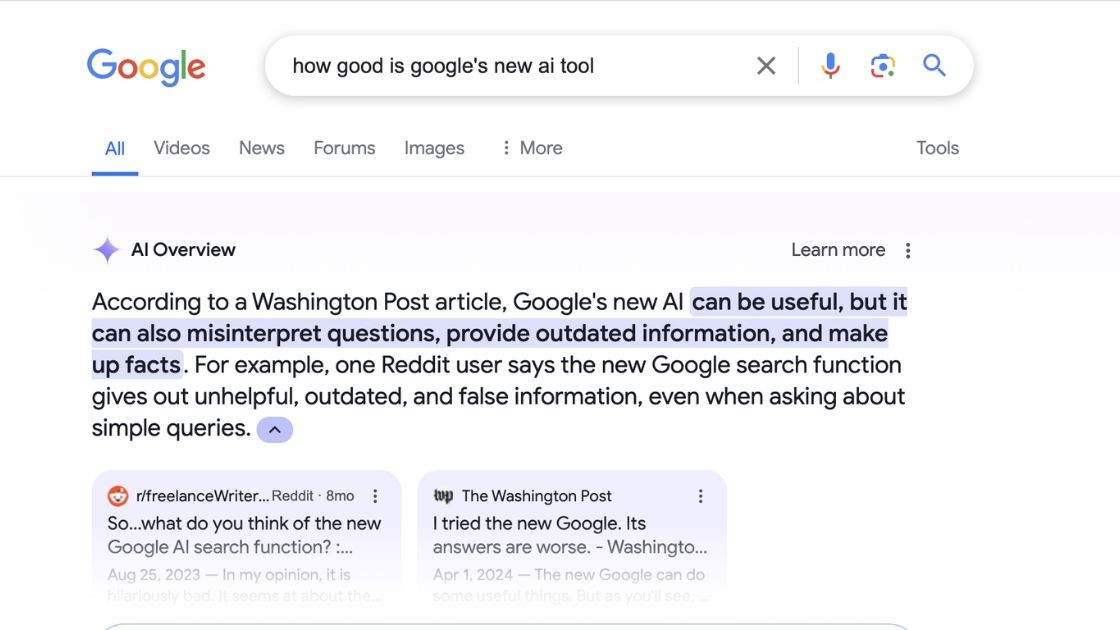
Google AI Can Get Business Information Wrong
A recent Business Insider investigation documented several small business owners dealing with inaccurate Google AI Overviews.
In one case, Google reportedly described customer feedback for a business as overwhelmingly negative. The complaints included issues with deliveries, damaged products and customer service.
There was one major problem.
The reviews apparently belonged to other businesses.
Another business owner said Google's AI appeared to be combining her property management company with similarly named businesses, including companies in other locations.
Think about what that means from a marketing perspective.
A customer does not necessarily know that Google has mixed two companies together.
They see Google.
They see a polished summary.
They assume the information is accurate.
And then they move on to the next business.
Your Website May No Longer Be the Customer's First Impression
For years, businesses have treated their websites as their digital storefront.
That may be changing.
Your Google Business Profile became another storefront.
Your reviews became another.
Social media became another.
Now AI search is creating something different.
It is creating a summary of your reputation.
When someone searches for your business, Google's AI can potentially interpret what your website says, what other websites say, what customers say, and what discussions across the internet say.
The result might become the customer's first meaningful interaction with your brand.
They may never reach your homepage.
Research released in August 2026 examined Google searches from a panel of 900 U.S. adults. The researchers found that when an AI Overview appeared, people clicked sources cited within the overview during only about 1% of those visits. AI Overviews were also associated with fewer clicks and more searches ending without the user continuing to another website.
That should get the attention of anyone responsible for SEO.
The battle is no longer only about earning the click.
Sometimes the battle happens before the click exists.
SEO Is Slowly Becoming Reputation Management
Traditional SEO asked:
Does Google understand my website?
The next version of SEO also needs to ask:
Does Google understand my business?
Those sound similar, but they are not the same thing.
You could have technically strong SEO and still have conflicting information about your company across the internet.
Maybe an old directory still has your previous address.
Maybe an abandoned social profile lists services you no longer provide.
Maybe another company has a very similar name.
Maybe old reviews describe something that has since changed.
Maybe articles, forums or third party websites contain outdated information.
When Google's AI searches across multiple sources, those inconsistencies matter.
This is why AI search reputation management is becoming increasingly relevant.
Businesses need to think beyond what appears on their own website and consider the broader picture search engines can build about them.
Search Your Own Business Like a Customer Would
One of the easiest things a business owner can do right now costs nothing.
Google your business.
But do not only search the company name.
Search the kinds of questions a potential customer might ask before buying.
Try searches like:
Is [company name] good?
[company name] reviews
Is [company name] legitimate?
[company name] complaints
Should I hire [company name]?
Best [your service] company in [your city]
[company name] vs [competitor]
Look at whether Google generates an AI Overview.
Then read it carefully.
Is the location correct?
Are the services correct?
Does it understand what your business actually does?
Does it confuse your company with another business?
Does it reference old information?
Are negative claims actually about your company?
This should become part of a modern brand audit.
Most businesses monitor reviews.
Far fewer are monitoring what AI says about them.
That probably needs to change.
What Should You Do If Google AI Gets Your Business Wrong?
There is no magic button that gives a business complete control over an AI Overview.
That makes prevention especially important.
There are, however, several things businesses should be doing.
Keep Your Google Business Profile Accurate
Your address, phone number, website, business category, hours and services should all be current.
Google specifically recommends keeping Business Profile information updated as part of maintaining visibility in its AI search experiences.
This has always mattered for local SEO.
It may matter even more when AI systems are trying to build a complete understanding of your business.
Make Your Website Extremely Clear About Who You Are
Do not make Google hunt for basic information.
Your website should clearly communicate:
Your company name.
Your locations.
Your services.
The markets you serve.
How customers contact you.
What makes your company different.
Information about your team where appropriate.
If your company has a similar name to another business, clarity becomes even more important.
Google's latest guidance also emphasizes original, useful and first hand content instead of generic information that could have been published by anyone.
That means your website should not simply contain another version of the same generic service page your competitors have.
Give Google information that could only realistically come from your business.
Keep Information Consistent Across the Web
Check major directories, social profiles, business listings and industry websites.
Your name, location, phone number and basic company information should tell the same story.
One outdated listing might not destroy your online reputation.
Dozens of conflicting signals are a different story.
If Google is trying to understand who your company is, make the answer easy.
Build Real Third Party Validation
Your own website will always say your business is great.
Google knows that.
Customers know that too.
Independent information carries a different kind of weight.
Real customer reviews, legitimate media mentions, industry references, partnerships and authoritative third party profiles help create a larger picture around a brand.
The important word is real.
Google specifically warned in its August 2026 AI search guidance against pursuing artificial mentions simply to influence generative search.
Trying to manufacture hundreds of fake conversations about your business is not a sustainable AI SEO strategy.
Building a business people genuinely talk about is.
Publish Content Based on Actual Experience
There is an interesting irony in AI search.
As more generic AI generated content floods the internet, actual experience becomes more valuable.
Google's newest guidance specifically encourages unique viewpoints, original expertise and content based on first hand experience rather than simply recycling information already available online.
So instead of publishing:
"5 Benefits of Hiring a Pest Control Company"
a pest control company might publish:
"What We Found After Inspecting 500 Homes With Ant Problems"
Instead of:
"Why PPC Is Important for Small Businesses"
a marketing company could publish:
"What Happened When We Cut Cost Per Sale Instead of Increasing Ad Spend"
One could have been written by anyone.
The other comes from experience.
That distinction matters for readers, and increasingly it matters for search.
Should Businesses Start Optimizing for AI Instead of Google?
Not exactly.
There is a lot of new terminology appearing in marketing right now.
You may hear about GEO, or Generative Engine Optimization.
You may hear about AEO, or Answer Engine Optimization.
You may hear agencies promise they have discovered some new trick for ranking inside AI.
Google's own position is much less exciting.
Google says SEO is still relevant.
Its generative search systems remain connected to Google's existing search and quality systems. Google says businesses do not need special AI files, special AI markup or an entirely separate optimization strategy to appear in AI Overviews.
Good SEO is not dead.
The definition of good SEO is simply getting broader.
Technical SEO matters.
Content matters.
Authority matters.
Reviews matter.
Brand reputation matters.
Consistency matters.
And now businesses also need to understand how AI interprets all of those signals together.
Ranking Number One Is Not Enough Anymore
There was a time when getting the top organic position felt like winning.
Today, a customer might see an AI generated answer before they ever reach that position.
That means marketers need to start asking better questions.
Not:
How much traffic did we generate?
But:
How much qualified business did we generate?
Not:
Where do we rank?
But:
What does a customer see when they search for us?
Not:
How many impressions did we get?
But:
What happened after those impressions?
This is one of the reasons performance measurement matters so much.
Search engines will change.
AI will change.
Advertising platforms will change.
Algorithms will absolutely change.
Revenue is still revenue.
A qualified lead is still a qualified lead.
A new customer is still a new customer.
The New Search Result Is Your Reputation
Google AI Overviews are not a reason to panic.
They are a reason to pay attention.
Search your company.
Read what Google says.
Check what other websites say.
Correct outdated information.
Build a strong review profile.
Publish information based on actual experience.
Keep your business details consistent.
And remember that SEO is no longer simply about convincing Google that your webpage deserves to rank.
Increasingly, it is about making sure Google actually understands the business behind the webpage.
Because your next customer may ask Google about you before they ever talk to you.
And the answer Google gives them could determine whether they ever do.
Imagine spending years building a business.
You collect reviews. You improve your website. You invest in SEO. You pay for Google Ads. You work hard to make sure that when someone searches for your company, they find something that represents the business you actually built.
Then Google summarizes your business for them… and Google gets it wrong.
That is no longer a hypothetical problem. As Google AI Overviews become a bigger part of search, business owners have a new reputation problem to think about. Customers may form an opinion about your company before visiting your website, reading your reviews, or even clicking a search result.
Google's AI may do that work for them. For small businesses, that changes the meaning of SEO.
Ranking is still important. But increasingly, businesses also need to pay attention to what Google AI says about them when they rank.
What Are Google AI Overviews?
Google AI Overviews are AI generated answers that can appear directly in Google Search.
Instead of only displaying the familiar list of websites, Google can collect information from multiple sources and create a summary designed to answer the searcher's question immediately.
Someone searching for a company might ask:
"Is ABC Roofing a good company?"
"What are the reviews for ABC Roofing?"
"Is ABC Plumbing reliable?"
"Best pest control company near me."
"Problems with ABC Property Management."
Google can now interpret information from around the web and provide an answer before the customer visits any of those websites.
Google says its AI search features use information from its search index and can perform multiple related searches to build an answer. Its systems may look across different pages and sources before generating the response.
That is useful when the information is correct.
The problem comes when it isn't.
Google AI Can Get Business Information Wrong
A recent Business Insider investigation documented several small business owners dealing with inaccurate Google AI Overviews.
In one case, Google reportedly described customer feedback for a business as overwhelmingly negative. The complaints included issues with deliveries, damaged products and customer service.
There was one major problem.
The reviews apparently belonged to other businesses.
Another business owner said Google's AI appeared to be combining her property management company with similarly named businesses, including companies in other locations.
Think about what that means from a marketing perspective.
A customer does not necessarily know that Google has mixed two companies together.
They see Google.
They see a polished summary.
They assume the information is accurate.
And then they move on to the next business.
Your Website May No Longer Be the Customer's First Impression
For years, businesses have treated their websites as their digital storefront.
That may be changing.
Your Google Business Profile became another storefront.
Your reviews became another.
Social media became another.
Now AI search is creating something different.
It is creating a summary of your reputation.
When someone searches for your business, Google's AI can potentially interpret what your website says, what other websites say, what customers say, and what discussions across the internet say.
The result might become the customer's first meaningful interaction with your brand.
They may never reach your homepage.
Research released in August 2026 examined Google searches from a panel of 900 U.S. adults. The researchers found that when an AI Overview appeared, people clicked sources cited within the overview during only about 1% of those visits. AI Overviews were also associated with fewer clicks and more searches ending without the user continuing to another website.
That should get the attention of anyone responsible for SEO.
The battle is no longer only about earning the click.
Sometimes the battle happens before the click exists.
SEO Is Slowly Becoming Reputation Management
Traditional SEO asked:
Does Google understand my website?
The next version of SEO also needs to ask:
Does Google understand my business?
Those sound similar, but they are not the same thing.
You could have technically strong SEO and still have conflicting information about your company across the internet.
Maybe an old directory still has your previous address.
Maybe an abandoned social profile lists services you no longer provide.
Maybe another company has a very similar name.
Maybe old reviews describe something that has since changed.
Maybe articles, forums or third party websites contain outdated information.
When Google's AI searches across multiple sources, those inconsistencies matter.
This is why AI search reputation management is becoming increasingly relevant.
Businesses need to think beyond what appears on their own website and consider the broader picture search engines can build about them.
Search Your Own Business Like a Customer Would
One of the easiest things a business owner can do right now costs nothing.
Google your business.
But do not only search the company name.
Search the kinds of questions a potential customer might ask before buying.
Try searches like:
Is [company name] good?
[company name] reviews
Is [company name] legitimate?
[company name] complaints
Should I hire [company name]?
Best [your service] company in [your city]
[company name] vs [competitor]
Look at whether Google generates an AI Overview.
Then read it carefully.
Is the location correct?
Are the services correct?
Does it understand what your business actually does?
Does it confuse your company with another business?
Does it reference old information?
Are negative claims actually about your company?
This should become part of a modern brand audit.
Most businesses monitor reviews.
Far fewer are monitoring what AI says about them.
That probably needs to change.
What Should You Do If Google AI Gets Your Business Wrong?
There is no magic button that gives a business complete control over an AI Overview.
That makes prevention especially important.
There are, however, several things businesses should be doing.
Keep Your Google Business Profile Accurate
Your address, phone number, website, business category, hours and services should all be current.
Google specifically recommends keeping Business Profile information updated as part of maintaining visibility in its AI search experiences.
This has always mattered for local SEO.
It may matter even more when AI systems are trying to build a complete understanding of your business.
Make Your Website Extremely Clear About Who You Are
Do not make Google hunt for basic information.
Your website should clearly communicate:
Your company name.
Your locations.
Your services.
The markets you serve.
How customers contact you.
What makes your company different.
Information about your team where appropriate.
If your company has a similar name to another business, clarity becomes even more important.
Google's latest guidance also emphasizes original, useful and first hand content instead of generic information that could have been published by anyone.
That means your website should not simply contain another version of the same generic service page your competitors have.
Give Google information that could only realistically come from your business.
Keep Information Consistent Across the Web
Check major directories, social profiles, business listings and industry websites.
Your name, location, phone number and basic company information should tell the same story.
One outdated listing might not destroy your online reputation.
Dozens of conflicting signals are a different story.
If Google is trying to understand who your company is, make the answer easy.
Build Real Third Party Validation
Your own website will always say your business is great.
Google knows that.
Customers know that too.
Independent information carries a different kind of weight.
Real customer reviews, legitimate media mentions, industry references, partnerships and authoritative third party profiles help create a larger picture around a brand.
The important word is real.
Google specifically warned in its August 2026 AI search guidance against pursuing artificial mentions simply to influence generative search.
Trying to manufacture hundreds of fake conversations about your business is not a sustainable AI SEO strategy.
Building a business people genuinely talk about is.
Publish Content Based on Actual Experience
There is an interesting irony in AI search.
As more generic AI generated content floods the internet, actual experience becomes more valuable.
Google's newest guidance specifically encourages unique viewpoints, original expertise and content based on first hand experience rather than simply recycling information already available online.
So instead of publishing:
"5 Benefits of Hiring a Pest Control Company"
a pest control company might publish:
"What We Found After Inspecting 500 Homes With Ant Problems"
Instead of:
"Why PPC Is Important for Small Businesses"
a marketing company could publish:
"What Happened When We Cut Cost Per Sale Instead of Increasing Ad Spend"
One could have been written by anyone.
The other comes from experience.
That distinction matters for readers, and increasingly it matters for search.
Should Businesses Start Optimizing for AI Instead of Google?
Not exactly.
There is a lot of new terminology appearing in marketing right now.
You may hear about GEO, or Generative Engine Optimization.
You may hear about AEO, or Answer Engine Optimization.
You may hear agencies promise they have discovered some new trick for ranking inside AI.
Google's own position is much less exciting.
Google says SEO is still relevant.
Its generative search systems remain connected to Google's existing search and quality systems. Google says businesses do not need special AI files, special AI markup or an entirely separate optimization strategy to appear in AI Overviews.
Good SEO is not dead.
The definition of good SEO is simply getting broader.
Technical SEO matters.
Content matters.
Authority matters.
Reviews matter.
Brand reputation matters.
Consistency matters.
And now businesses also need to understand how AI interprets all of those signals together.
Ranking Number One Is Not Enough Anymore
There was a time when getting the top organic position felt like winning.
Today, a customer might see an AI generated answer before they ever reach that position.
That means marketers need to start asking better questions.
Not:
How much traffic did we generate?
But:
How much qualified business did we generate?
Not:
Where do we rank?
But:
What does a customer see when they search for us?
Not:
How many impressions did we get?
But:
What happened after those impressions?
This is one of the reasons performance measurement matters so much.
Search engines will change.
AI will change.
Advertising platforms will change.
Algorithms will absolutely change.
Revenue is still revenue.
A qualified lead is still a qualified lead.
A new customer is still a new customer.
The New Search Result Is Your Reputation
Google AI Overviews are not a reason to panic.
They are a reason to pay attention.
Search your company.
Read what Google says.
Check what other websites say.
Correct outdated information.
Build a strong review profile.
Publish information based on actual experience.
Keep your business details consistent.
And remember that SEO is no longer simply about convincing Google that your webpage deserves to rank.
Increasingly, it is about making sure Google actually understands the business behind the webpage.
Because your next customer may ask Google about you before they ever talk to you.
And the answer Google gives them could determine whether they ever do.